Blog
HVAC Inspection Report Template: Free Copy + How to Write a Professional Report
A professional HVAC inspection report should identify the equipment, document the condition of every component checked, record the readings the technician took, include photos of anything worth flagging, list recommendations, and capture a customer signature. That is the short answer. Here is the longer one — plus a free template you can copy today.
For an HVAC company, the report is where trust is won or lost. The customer cannot see inside their air handler. They cannot tell whether the tech who just spent forty minutes in the attic actually checked anything. The report is the proof — and when it documents a weak capacitor or a rusting heat exchanger clearly, it is also what turns a tune-up visit into a repair job the customer says yes to.
Below is exactly what to include, a free HVAC inspection report template, and the mistakes that make reports look amateur.
What to Include in an HVAC Inspection Report
Every HVAC report should cover these sections. Together they double as an HVAC inspection checklist template your techs can follow on every visit.
1. Technician and Company Information
- Technician name and license or certification number
- Company name, phone, email
- Company logo — the report represents your brand
2. Customer and Property Details
- Customer name
- Service address (the property inspected, not the billing address)
- Date and time of the visit
- Service type: maintenance visit, pre-season tune-up, diagnostic call, or pre-repair inspection
3. System Information
HVAC reports have a section most trades do not need: the equipment itself. Record it once and the report instantly reads more professional:
- Equipment type — split system, package unit, heat pump, furnace, mini-split
- Brand, model, and serial number — from the data plate
- Approximate age — customers make replace-or-repair decisions on this
- Filter size — saves the next visit ten minutes
- Refrigerant type — as listed on the equipment
4. Condition Findings (Component by Component)
The core of the report. Each item gets a condition rating: Pass, Needs Attention, or Fail. A thorough HVAC inspection typically covers:
- Thermostat — operates and reads correctly, cycles the system
- Air filter — condition and fit
- Electrical connections and contactor — tight, no pitting or scorching
- Capacitor — physical condition and reading
- Refrigerant lines and insulation — intact, no oil staining at joints
- Condensate drain and pan — clear, draining, no standing water or rust
- Blower assembly — clean, spins freely, belt condition where applicable
- Evaporator coil — clean, no ice, no visible corrosion
- Condenser coil — clean, fins straight, clear of debris
- Heat exchanger — visual condition, no cracks or heavy corrosion visible
- Safety controls — limit switches and float switch respond
- Visible ductwork — connected, sealed, insulation intact
5. Measurements
Readings separate a real inspection report from a glorified visit receipt. Record them as numbers, not impressions:
- Return air temperature and supply air temperature — and the temperature split between them
- Voltage and amp draw at the unit
- Capacitor reading versus its rated value
A tech who writes "cooling fine" has an opinion. A tech who writes the actual supply and return temperatures has evidence.
6. Photos
Photograph the data plate, the filter as found, and every component rated "Needs Attention" or "Fail." A photo of a corroded contactor sells the repair better than any paragraph — and protects you if the customer later disputes what you reported.
7. Recommendations and Next Steps
For every item that is not a Pass: what should happen, how urgent it is, and an estimated cost where you can give one. Documented clearly, this is honest professional guidance — and it is also where maintenance visits turn into booked repair work.
8. Signatures
The customer signs to confirm they received the report and were informed of the findings. If a flagged component fails two months later, the signed report is your record that the customer knew.
Free HVAC Inspection Report Template
Copy this HVAC inspection report template and adapt it for your business. Replace the bracketed fields with your information.
HVAC INSPECTION REPORT

Company: [Your Company Name]
Technician: [Full Name] | License / Cert #: [Number]
Phone: [Phone] | Email: [Email]

─────────────────────────────────────────

Customer: [Customer Full Name]
Service Address: [Street, City, State, ZIP]
Date of Visit: [MM/DD/YYYY]
Service Type: [ ] Maintenance  [ ] Tune-Up  [ ] Diagnostic  [ ] Pre-Repair

─────────────────────────────────────────

SYSTEM INFORMATION
Equipment Type: [ ] Split  [ ] Package  [ ] Heat Pump  [ ] Furnace  [ ] Mini-Split
Brand / Model: [Brand, Model Number]
Serial Number: [Serial]
Approx. Age: [Years]   Filter Size: [Size]
Refrigerant Type (per data plate): [Type]

─────────────────────────────────────────

FINDINGS
                                    Pass | Needs Attention | Fail
Thermostat operation                [  ] |      [  ]       | [  ]
Air filter condition                [  ] |      [  ]       | [  ]
Electrical connections / contactor  [  ] |      [  ]       | [  ]
Capacitor                           [  ] |      [  ]       | [  ]
Refrigerant lines & insulation      [  ] |      [  ]       | [  ]
Condensate drain and pan            [  ] |      [  ]       | [  ]
Blower assembly                     [  ] |      [  ]       | [  ]
Evaporator coil                     [  ] |      [  ]       | [  ]
Condenser coil                      [  ] |      [  ]       | [  ]
Heat exchanger (visual)             [  ] |      [  ]       | [  ]
Safety controls                     [  ] |      [  ]       | [  ]
Visible ductwork                    [  ] |      [  ]       | [  ]

─────────────────────────────────────────

MEASUREMENTS
Return Air Temp: [    °F]     Supply Air Temp: [    °F]
Temperature Split: [    °F]
Voltage: [    V]              Amp Draw: [    A]
Capacitor Reading: [    ] vs Rated: [    ]

─────────────────────────────────────────

NOTES / DETAILED FINDINGS:
[Describe each issue found. Be specific — component,
location, severity, and what you observed.]

RECOMMENDATIONS:
1. [Recommendation + urgency level]
2. [Recommendation + urgency level]
3. [Recommendation + urgency level]

PHOTOS ATTACHED: [ ] Yes  [ ] No
Number of photos: [  ]

─────────────────────────────────────────

Customer Signature: ______________________
Date: ______________________

Technician Signature: ______________________
Date: ______________________
Common Mistakes to Avoid
- No measurements recorded. A findings table with no readings behind it convinces nobody. The numbers are what make the report professional — and what let you compare this visit to the next one.
- Photos with no context. Ten unlabeled photos of the inside of an air handler mean nothing to a homeowner. Tie each photo to the finding it documents.
- Vague recommendations. "Keep an eye on the capacitor" is not a next step. "Capacitor reading below rated value — recommend replacement at next visit, estimate attached" is.
- Skipping the system information. Without brand, model, and age on record, every future visit starts from zero and every replace-or-repair conversation is guesswork.
- No customer signature. If you documented a failing component and the customer declined the repair, the signature is your proof they were told.
The Faster Way: Build It Once in an App
If your techs fill this template out by hand or retype it in Word after every visit, you are spending 20 to 30 minutes per job on paperwork — and the quality depends on who is writing.
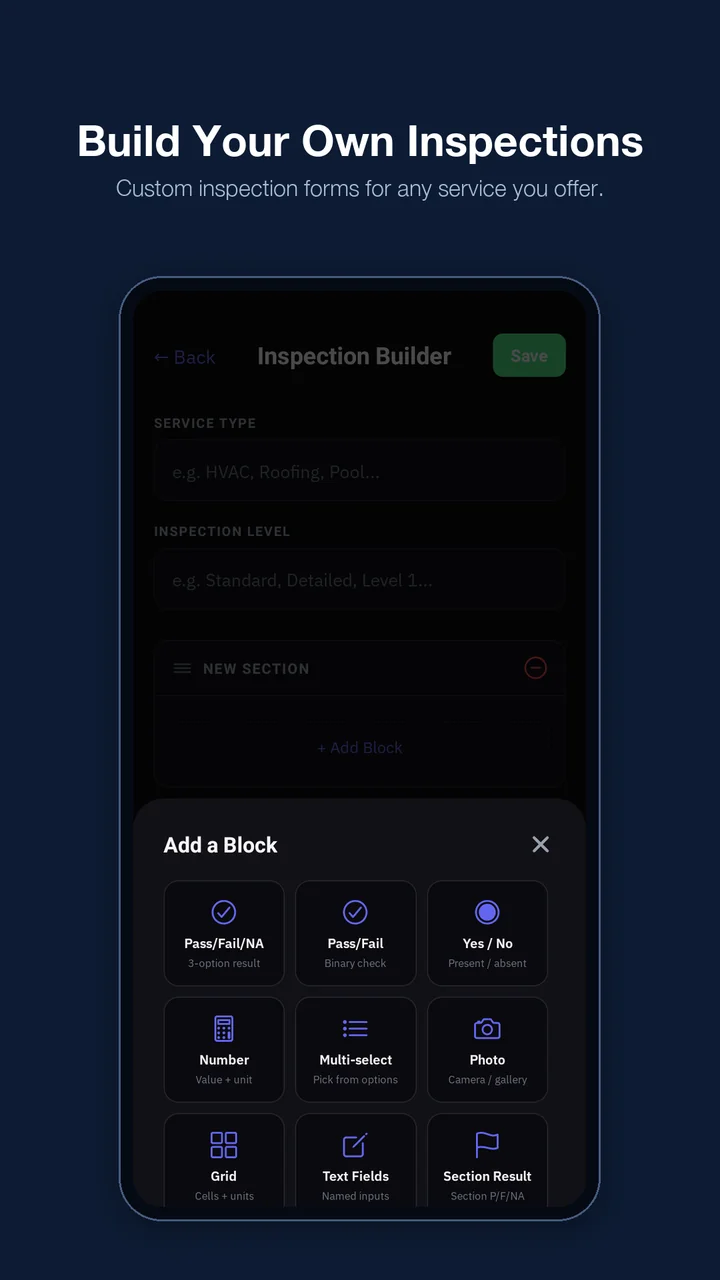
ProField's HVAC inspection app turns this exact template into a tap-through checklist using its Custom Inspection Builder: pass/fail items, measurements with units, photo requirements, per-section results. Build it once, and every tech runs the same inspection while AI writes the customer-facing report in about 30 seconds. The customer signs on the phone, and a branded PDF is emailed before the truck leaves the driveway.
The cost? Credit packs start at $4.99 for 25 credits — one credit covers a complete report. Compare that to the time value of 20 minutes of manual paperwork.
Stop writing reports by hand.
Build your HVAC inspection once, and ProField turns every visit into a professional PDF in under 2 minutes. AI-written narrative, customer signature, instant delivery.
See PricingConclusion
A professional HVAC inspection report covers technician credentials, customer details, system information, component-by-component findings, real measurements, photos, recommendations, and a customer signature. Use the free template above as your starting point, avoid the mistakes that make reports read like visit receipts, and when you are ready to stop retyping the same document, an app like ProField turns it into a two-minute workflow.
The inspection is the work. The report is what the customer keeps.